Learn about and pray the rosary to meditate with Mary on the mysteries of Christ’s life.
The Rosary
Praying with Mary
“You watch over the Church, for you are its Mother. You watch over each of your children.” John Paul II (1980)
The rosary is a simple yet profound prayer in the Catholic tradition. It helps us meditate on the life of Jesus together with the Virgin Mary.
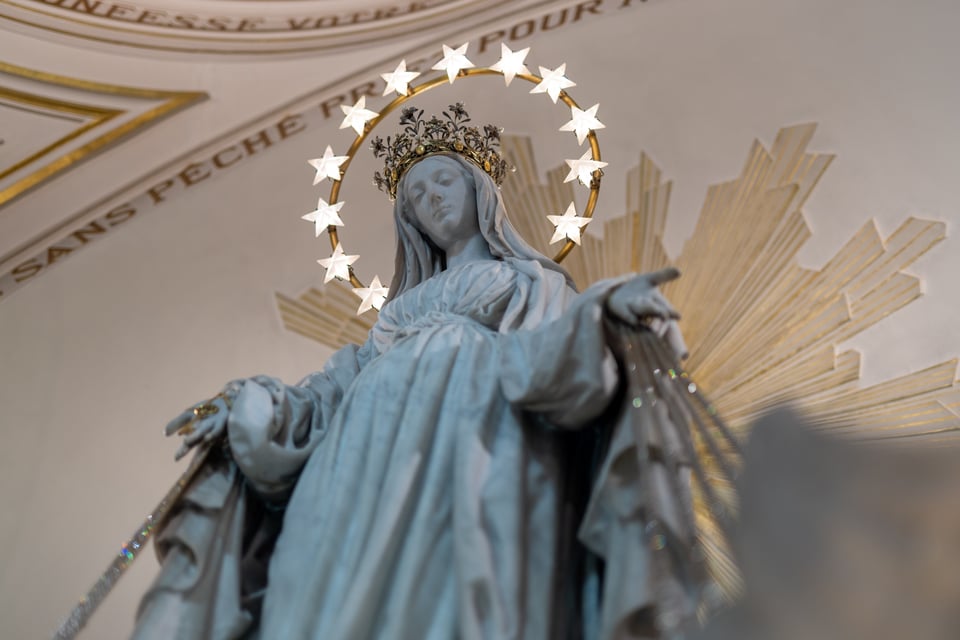
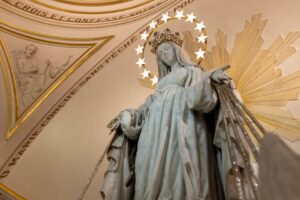
The rosary plays an important role at the Chapel of Our Lady of the Miraculous Medal. Many pilgrims come here to pray with Mary and entrust their intentions to her.
The rosary is a way of praying with the Virgin Mary while contemplating the life of Christ. It consists of repeated prayers: the Hail Mary, the Our Father, and the Glory Be. This repetition helps one enter into inner silence and meditate on the mysteries of the faith.
The rosary is therefore both a vocal prayer — because it is recited with words — and a meditative prayer — because it leads us to contemplate the events of salvation. The term “Rosary” often refers to the set of twenty mysteries divided into four sets: the Joyful, Luminous, Sorrowful, and Glorious Mysteries.
Schedule for the Rosary
Select a date
Tuesday of week 33 in Ordinary Time
Saint Elizabeth of Hungary (d. 1231)
No events scheduled for this date
How do you pray the rosary?
The rosary can be prayed alone, as a family, in a group, or at church. It usually begins with making the sign of the cross, followed by announcing the mystery you wish to meditate on. Next, one prays one Our Father, ten Hail Marys, and one Glory Be: this set of prayers is called a “decade.”
Each decade is tied to a mystery from the life of Christ and the Virgin Mary. While reciting the prayers, one meditates in one’s heart on the event evoked. To pray one rosary, one meditates on five mysteries; to pray the full rosary, one meditates on all twenty mysteries. The most important thing is not to rush, but to pray with faith and attention.
For centuries, Christians have loved to pray with Mary. Gradually, the Church developed a simple way to meditate on the Gospel by repeating the angel’s greeting to Mary and contemplating the great mysteries of Christ’s life. This prayer came to be known as the Rosary, meaning a wreath of roses offered to the Virgin Mary.
Over time, this prayer spread widely throughout the Church. It has nourished the faith of generations of Christians in families, parishes, monasteries, and shrines.
On the Rue du Bac, this prayer takes on a special significance. There, the Virgin Mary invited the faithful to come and pray with confidence. Indeed, the rosary helps us to enter into this childlike trust and to turn to God together with Mary.
I believe in God, the Father almighty, Creator of heaven and earth, and in Jesus Christ, his only Son, our Lord, who was conceived by the Holy Spirit, born of the Virgin Mary, suffered under Pontius Pilate, was crucified, died and was buried; he descended into hell; on the third day he rose again from the dead; he ascended into heaven, and is seated at the right hand of God the Father almighty; from there he will come to judge the living and the dead. I believe in the Holy Spirit, the holy catholic Church, the communion of saints, the forgiveness of sins, the resurrection of the body, and life everlasting. Amen.
Our Father, who art in heaven, hallowed be thy name; thy kingdom come, thy will be done on earth as it is in heaven. Give us this day our daily bread, and forgive us our trespasses, as we forgive those who trespass against us; and lead us not into temptation, but deliver us from evil. Amen.
Hail Mary, full of grace, the Lord is with you; blessed are you among women, and blessed is the fruit of your womb, Jesus. Holy Mary, Mother of God, pray for us sinners, now and at the hour of our death. Amen.