“There, a period of time passed, the sweetest of my life. It would be impossible for me to say what I experienced.”
Saint Catherine Labouré
In 1830, in the Chapel on Rue du Bac in Paris, the Virgin Mary appeared three times to a young Daughter of Charity, Saint Catherine Labouré.
These apparitions are the origin of the Miraculous Medal and have made this chapel a place of prayer and pilgrimage known throughout the world.
Catherine is 24 years old. She is a Seminary Sister (novice) and deeply desires to see the Virgin Mary. This desire will be granted in an unexpected way.
The first apparition took place on the night of July 18–19, 1830, the eve of the feast day of Saint Vincent de Paul.
Around 11:30 p.m., Catherine hears her name being called. A child is standing there, at the foot of her bed. He says to her:
“The Blessed Virgin is waiting for you.”
She gets up, gets dressed, and follows him to the chapel. Everywhere they walk is bathed in light.
When she enters the chapel, she hears what sounds like the rustle of a silk dress. The child said to her:
“Here is the Blessed Virgin.”
Catherine steps forward, kneels down, and places her hands on the lap of Mary, who is seated in a chair. She will remember this moment as the sweetest of her life.
The Virgin speaks to her at length. She entrusts her with a mission and gives her a fundamental message, pointing to the altar where the Eucharistic is celebrated:
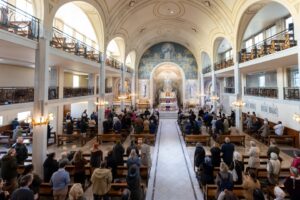
“Come to the foot of this altar. Here, graces will be showered on all those who ask for them with confidence and fervor.”
These words are at the heart of the Chapel’s message: they invite everyone to come and pray and ask for graces through the intercession of the Blessed Virgin Mary.

The second apparition took place on November 27, 1830, around 5:30 p.m., during evening prayer.
Catherine first sees the Virgin Mary standing on a half-globe, crushing a serpent. She is holding a globe topped with a cross in her hands.
A voice says to her:
“This globe represents the entire world, France, and each person in particular.”
Then the vision changes.
Mary’s hands extend outward, and beams of light descend toward the earth.
Catherine hears:
“These rays are the graces I pour out upon those who ask for them.”
The following prayer then appears around the Virgin:
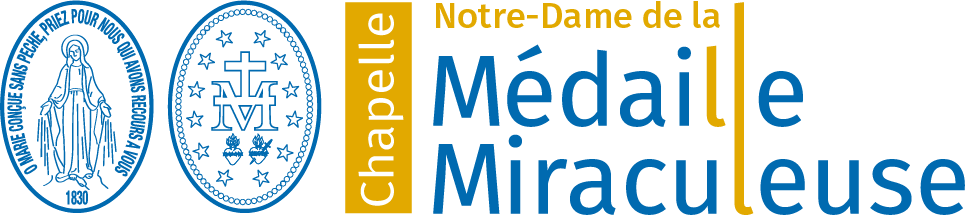
“O Mary conceived without sin, pray for us who have recourse to you.”
Then the picture turns round. Catherine sees the other side of the medal:
The Virgin tells her:
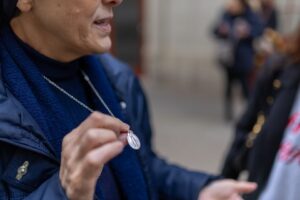
“Have a medal struck according to this model. For those who wear it with confidence there will be abundant graces.”
In this apparition, she gives the world the medal and her message.
The third apparition took place in December 1830 (the exact date is unknown).
This time, the Virgin appears near the altar, beside the tabernacle.
She confirms her mission to Catherine and tells her:
“You will not see me anymore.”
The apparitions come to an end.
Shortly thereafter, Catherine left Rue du Bac to care for the poor at the Enghien hospice. She would live there for the rest of her life, in simplicity and silence.
A Mission for the World
After the apparitions, Catherine spoke with her confessor, Father Aladel, a Vincentian priest.
In 1832, during a cholera epidemic in Paris, the first medals were struck (made) and distributed.
Very soon, graces of healings, protection, conversions, etc. were reported.
The medal quickly spread throughout the world and would henceforth be known as the “Miraculous Medal.”
“Come to the foot of this altar. Here, graces will be showered on all those who ask for them with confidence and fervor.”