The Reliquary of Saint Catherine Labouré
The reliquary of Saint Catherine Labouré is located at the very spot where the apparition took place. In 1880, an altar was built at this site. In 1933, the saint’s reliquary was placed there.
“Whenever I go to the chapel, I put myself in the presence of our good Lord, and I say to him “Lord, I am here. Tell me what you would have me do.”
Saint Catherine Labouré
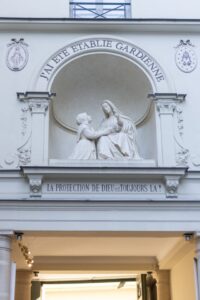
The Chapel of Our Lady of the Miraculous Medal is located at 140 Rue du Bac, in the Mother House of the Daughters of Charity.
Today, it is known throughout the world because of the apparitions of the Virgin Mary to Saint Catherine Labouré in 1830. But its history began before those events.
In 1813, an imperial decree granted the Daughters of Charity the Hôtel de Châtillon in order to establish their Mother House there. In 1815, the Sisters moved in even though the chapel was not yet fully completed.
On August 6, 1815, the Feast of the Transfiguration, the chapel was solemnly blessed. A few days later, the remains of Saint Vincent de Paul were placed beneath a side altar. In 1824, the remains of Saint Louise de Marillac were also transferred to the chapel.

In 1830, the chapel that Saint Catherine Labouré knew looked different from what we see today.
It did not yet have the current side aisles. The sanctuary was smaller, and the high altar was set further forward. The current corridor served as a passageway at that time, and a single balcony overlooked the entire space.
According to Catherine’s account, it was through this balcony that the Virgin Mary entered during the apparition on November 27, 1830.
Decorative elements in the chapel were also in different places. The painting of Saint Joseph was located where the Virgin holding the Globe now stands. The painting of Saint Anne was placed where the statue of Saint Joseph stands today. The marble high altar, now in the side chapel of Saint Vincent, was then at the center of the sanctuary.
The chapel was already dedicated to the Sacred Heart of Jesus.
These reference points help to better understand where the apparitions took place and why certain sites are particularly important to pilgrims.
Starting in 1849, the number of Sisters grew, and the chapel became too small.
Major renovations were undertaken. The right-hand corridor was moved, a side aisle was added, and the space was expanded to accommodate more worshipers. The walls were opened up, and the entire chapel was reorganized.
The sanctuary was also modified. The high altar was set back and raised. The side altars were moved.
In accordance with the message of the apparitions, a statue of the Virgin Mary was placed above the high altar. An initial plaster statue was replaced by the marble one we see today. It was created using blocks of marble donated in gratitude for the care provided by the Sisters during the cholera epidemic.
The Chapel is structured around a few key locations.
The reliquary of Saint Catherine Labouré is located at the very spot where the apparition took place. In 1880, an altar was built at this site. In 1933, the saint’s reliquary was placed there.
The reliquary of Saint Louise de Marillac is located at a side altar. Her relics have rested there since 1920. Beneath the reliquary, her spiritual testament recalls the essence of her mission: to serve the poor, to live in unity, and to entrust oneself to the Virgin Mary.
The altar of Saint Vincent de Paul preserves the original high altar from 1830. A mosaic created in 1934 commemorates the apparitions that took place at this site. In 1947, the relic of Saint Vincent’s heart was placed there.
The chapel also respects Saint Catherine’s wish to see the Virgin Mary depicted holding the globe.
After several attempts, a statue was installed at the desired location. In 1930, it was replaced by a statue made of Carrara marble. It depicts Mary offering the world to God.
The director’s chair, on which the Virgin Mary is said to have sat on the night of July 18, 1830, is also preserved. It was returned to the Chapel in 1880. It serves as an important place of prayer for pilgrims.
In 1930, to mark the centennial of the apparitions, the Chapel underwent extensive restoration. A new balcony was built, along with liturgical furnishings and a new lighting system.
The chapel feels brighter and more spacious.
Further work was carried out during the 20th century. After extensive restoration, the chapel was reopened on May 31, 1980, by Pope John Paul II.